
The moment you invest because everyone else is winning, you’ve already stopped investing and started gambling.


In financial markets, some of the biggest investing mistakes are not caused by lack of knowledge.
They are caused by human psychology.
One of the most powerful psychological forces that drives bad financial decisions is FOMO — Fear of Missing Out.
FOMO investing occurs when investors buy assets simply because others are making money from them. Instead of relying on research, valuation, or long-term strategy, decisions are driven by the fear that everyone else is getting rich while you are being left behind.
This behavior often leads investors to buy assets at the worst possible time — when prices are already extremely high.
Understanding FOMO investing is crucial for anyone who wants to build long-term wealth in the stock market.
What Is FOMO Investing?
FOMO investing happens when investors enter a market because they believe they are missing a profitable opportunity.
It usually appears during periods of rapid price increases, when an asset becomes widely discussed on social media, news channels, and among friends.
Common triggers include:
- A stock rising 50% in a few months
- Cryptocurrency prices surging rapidly
- A “hot” IPO getting massive attention
- Influencers claiming huge profits
Instead of asking “Is this investment fundamentally strong?”, people start asking “How much more can it go up?”
The fear of being left out becomes stronger than rational thinking.
The Psychology Behind FOMO
To understand FOMO investing, it is necessary to understand the human mind.
Financial markets are not driven only by numbers. They are driven by emotion, perception, and social behavior.
Several psychological forces contribute to FOMO.
Social Proof
Humans naturally assume that if many people are doing something, it must be correct.
When thousands of investors are buying the same asset, it creates the impression that the opportunity is legitimate.
But popularity does not equal value.
In fact, when an investment becomes extremely popular, it is often already overpriced.
Herd Mentality
Herd mentality occurs when individuals follow the behavior of the crowd.
In investing, this often means buying simply because everyone else is buying.
The danger of herd mentality is that crowds are often wrong at the extremes.
Markets frequently experience bubbles, where prices rise far beyond their real value because investors keep copying each other’s behavior.
Instant Gratification
Many investors today want quick profits.
Social media posts about massive trading gains create unrealistic expectations about how investing works.
Long-term investing requires patience. But FOMO pushes investors toward short-term speculation.
This leads people to chase trends rather than build sustainable portfolios.
Real Examples of FOMO Investing
Financial history is filled with examples where FOMO drove massive market bubbles.
The Dot-Com Bubble (2000)
During the late 1990s, internet companies became extremely popular.
Investors believed the internet would change the world — which was true.
However, investors began buying any company related to technology, regardless of profitability.
Stock prices skyrocketed, driven by excitement and speculation.
Eventually the bubble collapsed, wiping out trillions of dollars in market value.
Cryptocurrency Mania (2017 and 2021)
Cryptocurrency markets have experienced multiple waves of FOMO investing.
When Bitcoin and other cryptocurrencies surged dramatically, millions of new investors rushed into the market.
Many people bought cryptocurrencies after huge price increases, expecting prices to rise forever.
But markets eventually corrected sharply, causing large losses for late investors.
Meme Stock Craze
Stocks such as GameStop and AMC experienced massive price surges due to social media hype.
Online communities encouraged investors to buy these stocks regardless of fundamentals.
Many early participants made profits, but many late investors bought near the top and suffered heavy losses.
These events highlight how FOMO can override rational investment decisions.
Why FOMO Leads to Bad Investment Timing
One of the biggest problems with FOMO investing is timing.
When people experience FOMO, they usually enter the market after prices have already risen significantly.
At this stage:
- Early investors begin taking profits
- Valuations become stretched
- Market sentiment becomes overly optimistic
This creates a dangerous situation where new investors are buying from those who are already exiting.
Instead of buying low and selling high, FOMO investors often end up buying high and selling low.
The Role of Social Media in FOMO Investing
Social media platforms have dramatically amplified FOMO investing.
Investment ideas now spread rapidly through:
- YouTube
- Telegram groups
Many posts highlight massive profits but rarely show losses.
This creates a distorted perception that everyone else is making money easily.
In reality, markets involve risk, volatility, and uncertainty.
The constant exposure to success stories makes investors feel pressure to participate, even when they lack proper research or strategy.
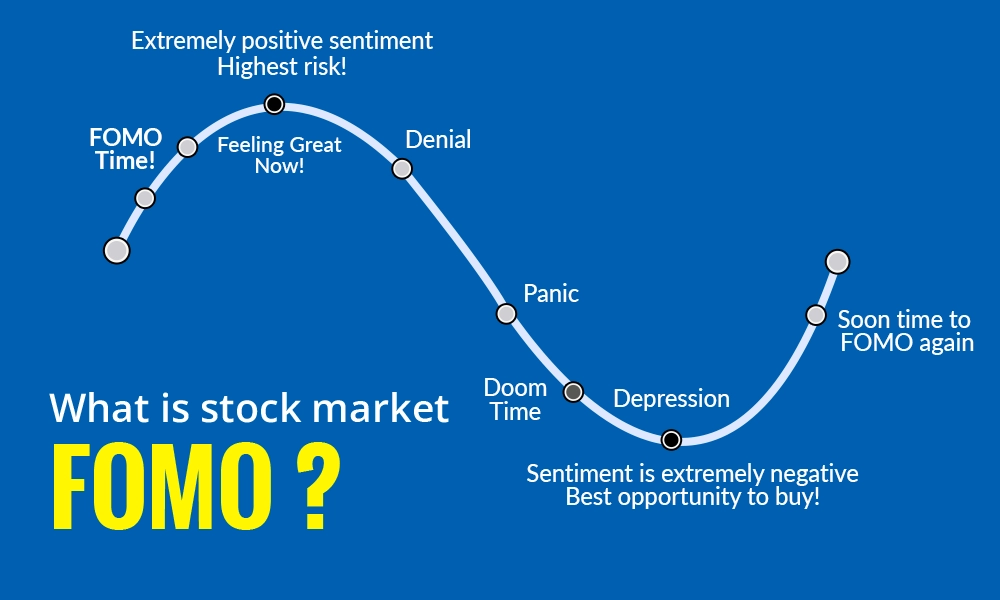
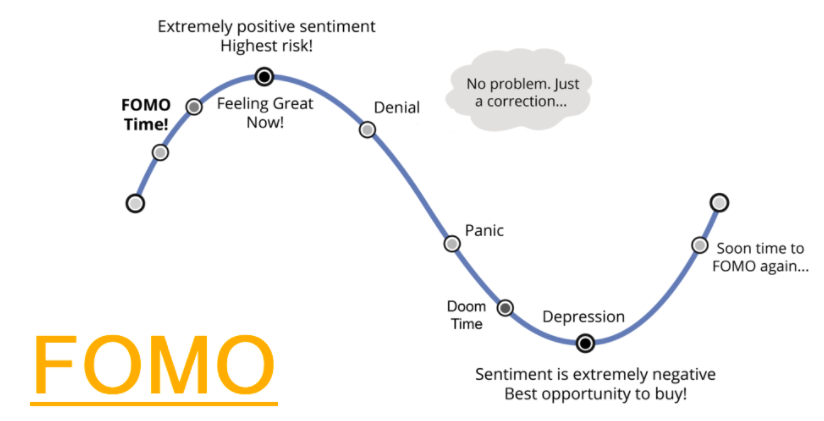
Emotional Cycle of Market Bubbles
Financial markets often follow a predictable emotional cycle.
It typically begins with optimism and excitement.
As prices continue rising, excitement turns into euphoria. Investors begin believing that prices will rise indefinitely.
During this phase, FOMO reaches its peak.
Eventually, reality returns. Prices stabilize or begin declining.
The emotional cycle then moves through anxiety, denial, panic, and regret.
Investors who entered due to FOMO often sell during panic — locking in losses.
Understanding this emotional cycle helps investors avoid being swept up by market hype.
Signs You Are Experiencing FOMO Investing
Many investors do not recognize FOMO while it is happening.
Some warning signs include:
- Buying an asset because it is trending online
- Investing without understanding the business or technology
- Feeling urgent pressure to buy quickly
- Ignoring valuation or risk factors
- Following investment advice from unverified sources
If an investment decision feels rushed and emotionally driven, FOMO may be influencing it.
Long-Term Consequences of FOMO Investing
FOMO investing can have several negative long-term effects.
Capital Loss
Buying assets at inflated prices increases the risk of large losses when markets correct.
Reduced Confidence
Experiencing major losses early in an investing journey can damage confidence and discourage future investing.
Poor Financial Discipline
FOMO encourages impulsive decision-making rather than systematic investing.
Over time, this behavior prevents investors from building a consistent strategy.
How Smart Investors Avoid FOMO
Successful investors recognize that markets will always produce exciting opportunities.
But they also understand that not every opportunity needs to be chased.
Several principles help protect against FOMO.
Develop a Clear Investment Strategy
Having a defined investment plan reduces the influence of emotions.
A strategy may include:
- Asset allocation targets
- Long-term investment horizon
- Rules for buying and selling
When decisions are guided by a plan, market hype becomes less influential.
Focus on Fundamentals
Instead of chasing price movements, evaluate investments based on their underlying value.
Important factors include:
- Revenue growth
- Profitability
- Competitive advantages
- Industry trends
Strong fundamentals provide a foundation for long-term returns.
Think Long-Term
Long-term investors recognize that wealth is built gradually through compounding.
Short-term market excitement rarely contributes to long-term financial success.
Patience allows investors to ignore temporary market noise.
Accept That Missing Opportunities Is Normal
No investor captures every profitable opportunity.
Even the most successful investors miss many trends.
Trying to participate in every opportunity leads to overtrading and emotional decision-making.
Successful investors focus only on opportunities that match their strategy.
The Discipline Advantage
One of the greatest advantages in investing is emotional discipline.
While many investors chase trends, disciplined investors remain patient and selective.
This patience allows them to buy assets when prices are reasonable rather than when excitement is at its peak.
Over time, disciplined behavior compounds into significant financial advantages.
Final Thoughts
FOMO investing is a powerful psychological trap that affects millions of investors.
It convinces people that opportunities must be seized immediately, even without proper research or strategy.
But financial markets reward patience, discipline, and rational thinking — not emotional reactions.
The most successful investors understand that wealth is built not by chasing every trend but by consistently making thoughtful, long-term decisions.
Opportunities will always exist in the market.
The real challenge is not finding opportunities.
The real challenge is having the discipline to ignore the wrong ones.
